
Best Pillow for Neck Pain: How to Choose the Right One
May 2026 · 7 minute read

Most people shopping for a pillow for neck pain are shopping by adjective. Soft, firm, plush, orthopedic. None of those words describe a measurement, which is why two pillows sold with identical language can feel completely different under your head.
There is no single best pillow for neck pain, because the correct pillow depends on the shape of your body and the position you sleep in. What does exist is a short list of variables worth checking before you buy, and a much shorter list of brands that publish them.
1. Loft height is the variable that matters most
Loft is the height of the pillow under your head once it has taken your weight. It decides the angle of your neck for the seven or eight hours you are not awake to correct it.
If the loft is too low, your head drops back and the muscles at the front of your neck stay lengthened all night. Too high, and your chin is pushed toward your chest. Either way you are holding a position you would never hold voluntarily while awake.
Side sleepers generally need more loft than back sleepers, because the distance from the outside of the shoulder to the side of the head is greater than the distance from the back of the shoulder to the back of the head. Broader shoulders need more again.
2. Firmness is about how long the support lasts
A soft pillow can feel supportive for the first twenty minutes and then compress to nothing. The useful question is not how firm a pillow feels in the shop, but how much of that height is still there at 4am.
Foam density, measured in kg/m³, is the honest proxy for this. Higher density foam resists compression for longer. It is rarely printed on a pillow listing, which is worth noting when you see one that does print it.
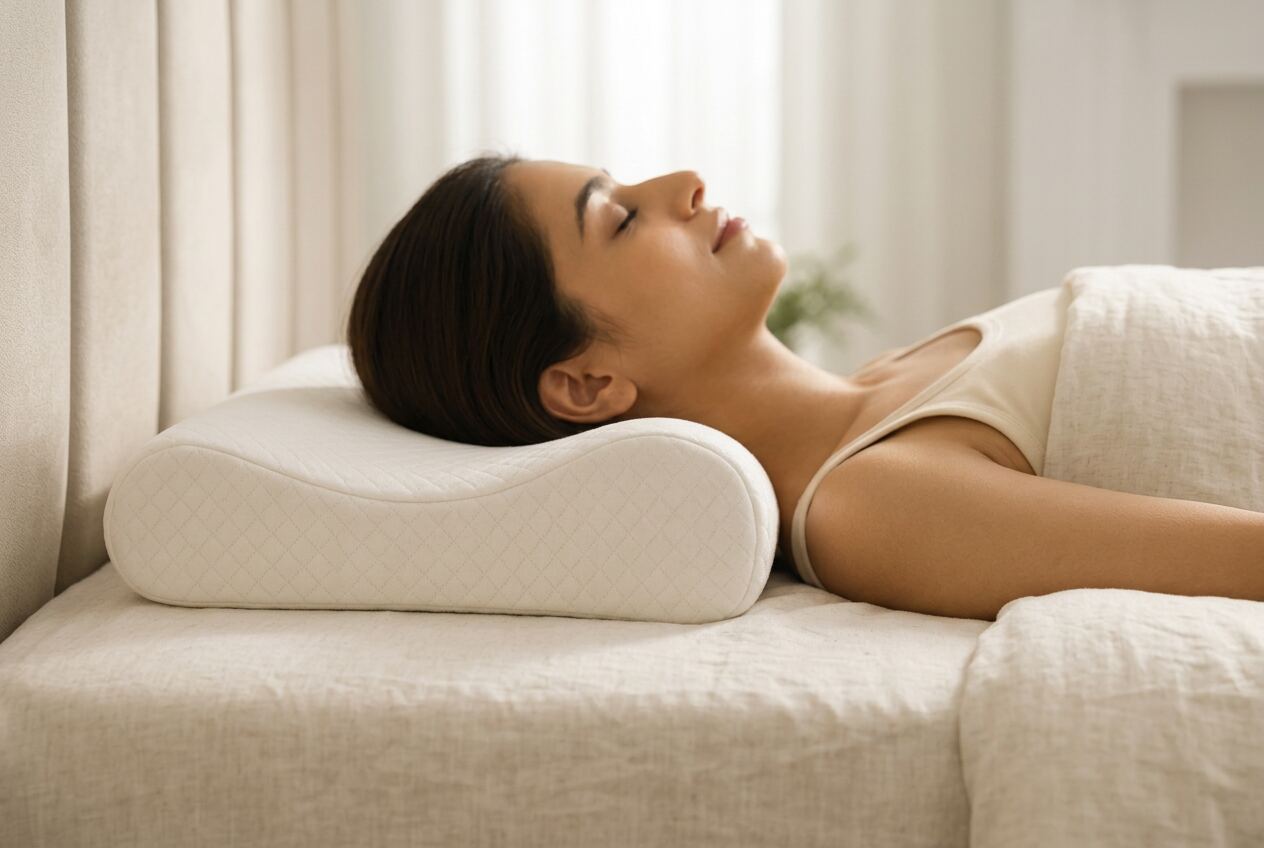
3. Shape decides whether your neck is supported or just your head
A flat pillow supports the back of the skull and leaves a gap under the cervical curve. That gap is why people wedge a folded towel under a flat pillow, which is a homemade version of a contour.
A contoured cervical pillow builds that shape in: a raised ridge that fills the space under the neck, and a lower well for the head. It is a fixed geometry, which is both the strength and the limitation. It supports one range of body sizes well rather than every body adequately.
4. Heat is a comfort variable, not a cosmetic one
In most of India, a pillow that retains heat gets flipped, punched and abandoned by the middle of the night, which undoes the support you paid for. Cover material and construction matter here as much as the foam.
Look for a breathable knitted cover, a stated GSM, and a cover you can actually remove and wash.
A short checklist before you buy
If a listing cannot answer these questions, you are buying on adjectives again.
- What is the loft height, in centimetres or inches, for each size?
- What is the foam density?
- Is the profile contoured or flat, and is the height fixed?
- What is the cover made from, and is it removable?
- Which sleeping positions is it designed for?
Where Nidra sits
We built the Nidra cervical pillow around exactly these four variables and publish each of them on the product page, including per-size loft and a foam density of 50 kg/m³ (±2). It is a contoured, medium-firmness profile intended for back and side sleepers.
It is not the right pillow for everyone. Front sleepers are the clearest exception, and any persistent pain deserves a physiotherapist before it deserves a purchase.
Nidra makes one product: a contoured pillow for neck pain with published loft, foam density and cover specifications, in three sizes.