Is a Memory Foam Pillow Good for Neck Pain?
March 2026 · 6 minute read
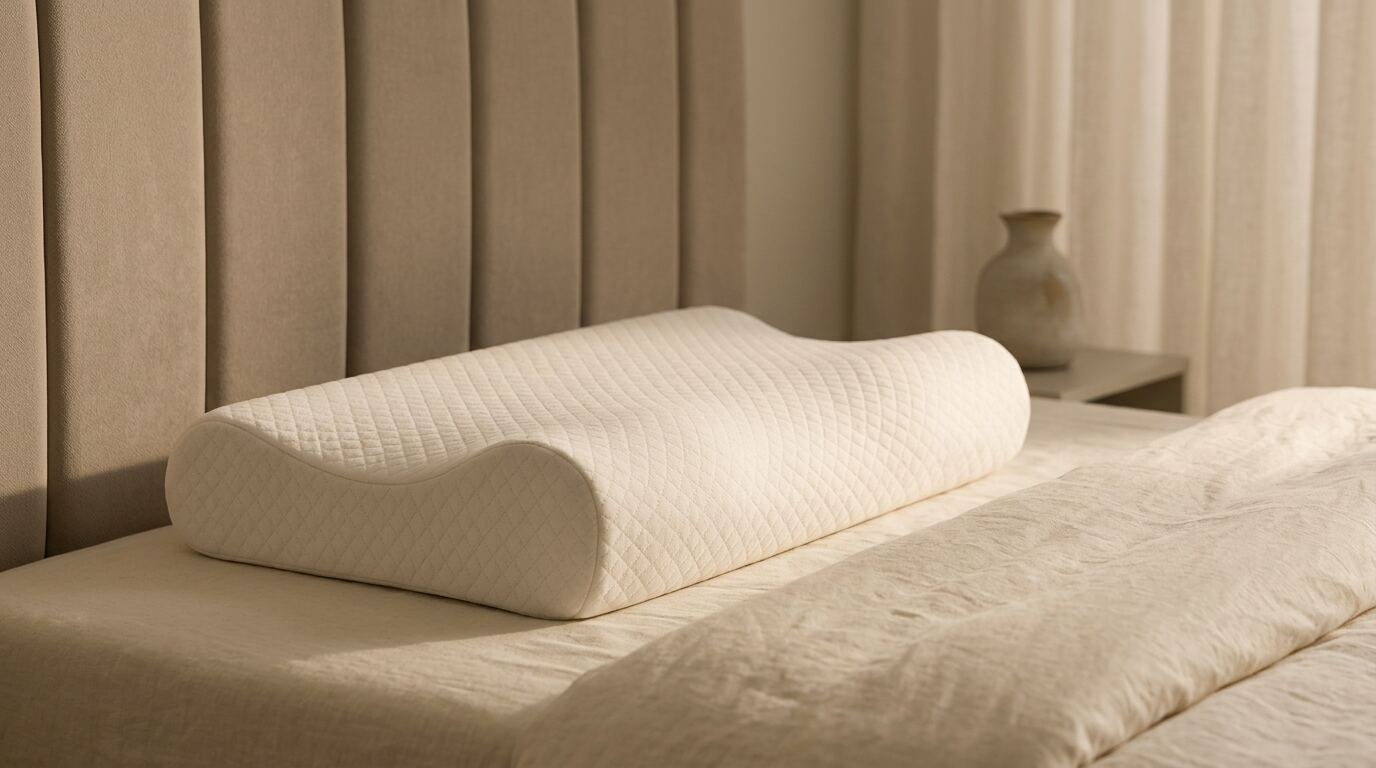
Memory foam has become shorthand for a good pillow, which is unhelpful, because memory foam describes a family of materials with an enormous quality range. A 25 kg/m³ foam and a 50 kg/m³ foam are both memory foam and behave nothing alike.
The useful question is narrower: what does memory foam do that matters for neck support, and what should you check before assuming a given memory foam pillow will help?
What memory foam does well
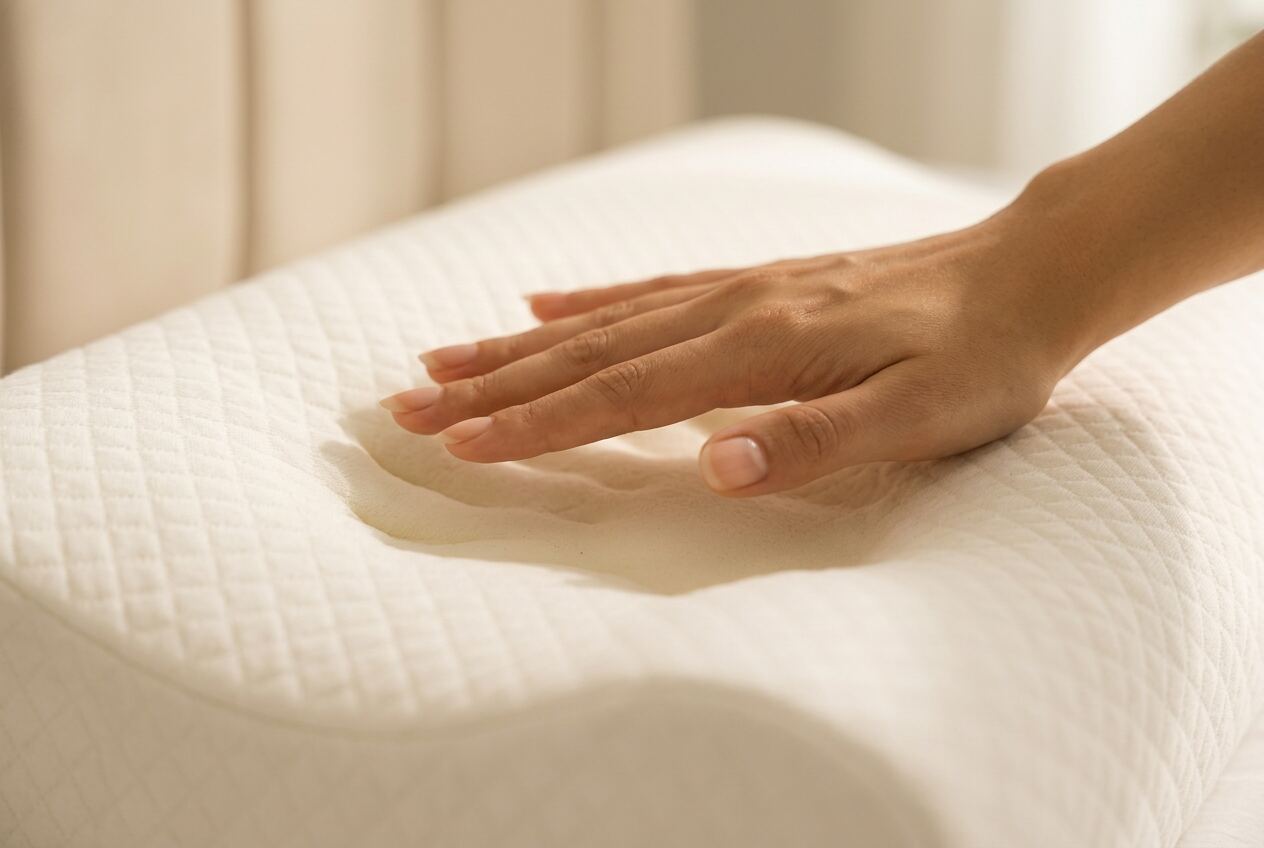
Memory foam is viscoelastic. It responds to pressure and warmth by yielding slowly, then recovers its shape once the load is removed. Two things follow from that.
First, it distributes pressure over a larger contact area instead of concentrating it, which is why foam feels less like a lump than compressed fibre. Second, and more importantly for the neck, it holds a shape. A shaped contour in foam is still that shape at 4am; a shaped contour in loose fill is not.
Where memory foam disappoints
Low-density foam compresses under a head and stays compressed, so the support height you chose is not the one you sleep on. Dense foam can also retain heat, which in an Indian summer is a real reason people abandon an otherwise well-shaped pillow.
And foam does not fix a wrong height. A well-made memory foam pillow at the wrong loft for your shoulders will still hold your neck at the wrong angle, very consistently.
The three numbers worth asking for
- Density, in kg/m³: the closest thing to a durability figure.
- Loft height, per size: the number that decides your neck angle.
- Cover material and GSM: the difference between breathable and hot.
How long adjustment takes
Moving from a soft fill pillow to shaped foam usually feels wrong for two to four nights. Your head is searching for the flat surface it is used to. Most people report it stops feeling unfamiliar within a week; if it still feels wrong after two, the height is more likely the problem than the material.
What we publish
Nidra's memory foam neck pillow uses a slow-recovery core at 50 kg/m³ (±2), a knitted jacquard poly-spun cover at 220 to 240 GSM that is removable and washable, and a published loft for each of the three sizes. Those are on the product page, not in a brochure.
It is orthopedic support equipment, not a treatment. It cannot resolve a disc problem or a nerve issue, and we will not pretend otherwise.
Nidra makes one product: a memory foam neck pillow with published loft, foam density and cover specifications, in three sizes.